
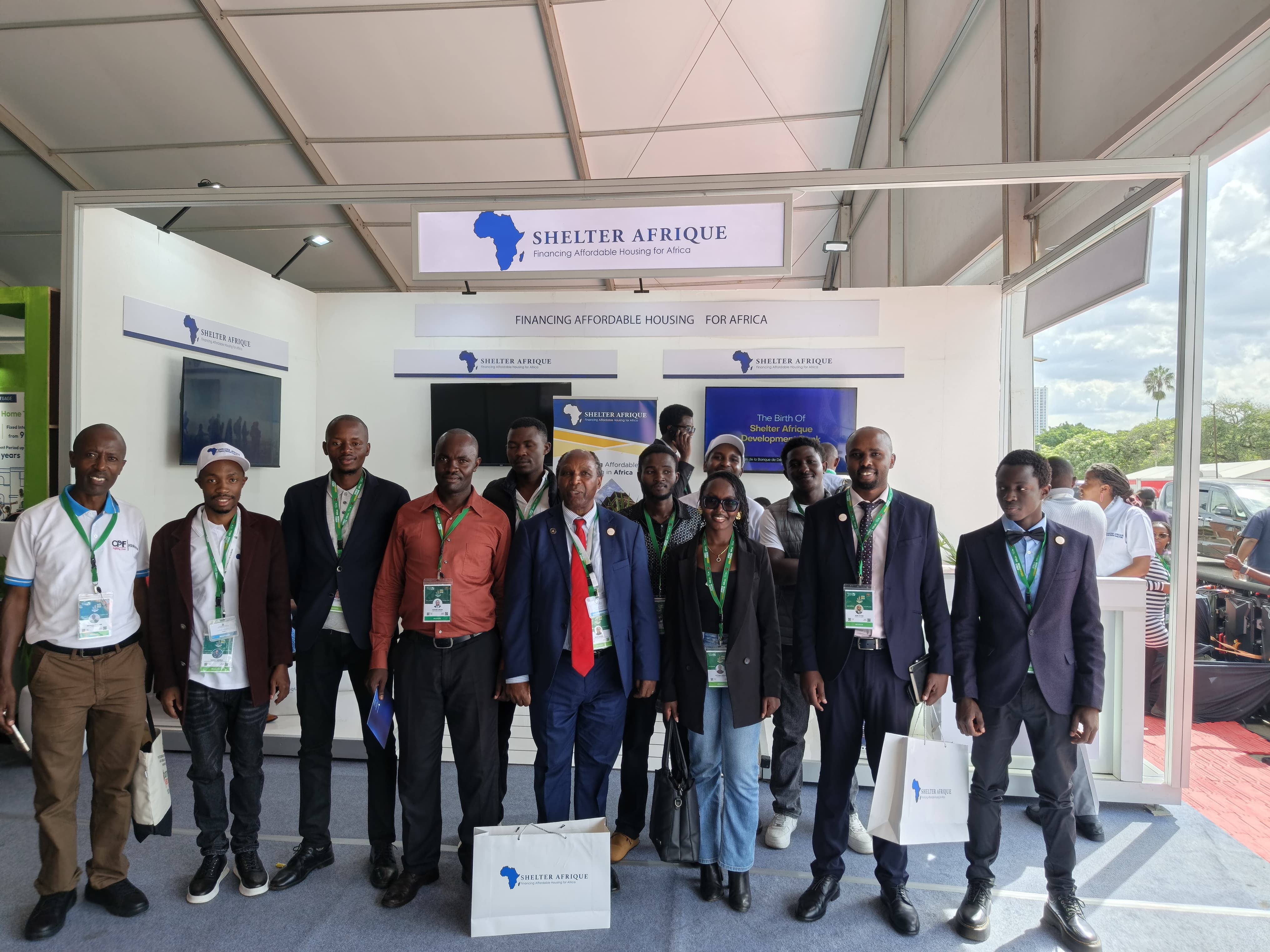
From 8 to 10 April 2026, five undergraduate students from the Faculty of Built Environment and Design stepped onto one of the continent’s most consequential platforms: the Second Africa Urban Forum (AUF2). Held at the Kenyatta International Convention Centre (KICC), the high-level summit placed these future industry leaders directly at the nexus of policy, finance, and sustainable development. They served as official volunteers supporting the Shelter Afrique Development Bank exhibition booth. For three days, they were not students observing from the periphery. They were inside the room where Africa’s urban future was being decided.
The team comprised Daniel Mwambua and Dennis Ndibaru (Real Estate, Fourth Year), Bridget Akinyi (Real Estate, Third Year), Emmanuel Barongo (Construction Management, Fourth Year), and Elizabeth Waiteiyo (Construction Management, Second Year). They represented the Faculty at a forum that drew heads of state, ministers, urban practitioners, and development finance leaders from across the continent. AUF2 convened under the theme “Adequate Housing for All: Advancing Socio-economic and Environmental Transformation towards the Realization of Agenda 2063.” Africa’s urban population is projected to double from 700 million to 1.4 billion by 2050, with nearly two-thirds of Africans expected to live in cities. The stakes on the exhibition floor were anything but academic.
Positioned at the Shelter Afrique Development Bank booth, the students were placed at the heart of the forum’s most practical conversations. Shelter Afrique exists to finance affordable housing and urban infrastructure across Africa. At AUF2, its booth was a gathering point for investors, policymakers, and development partners working to close the continent’s 53-million-unit housing deficit. “Working at the Shelter Afrique stand exposed us to real-time conversations shaping Africa’s housing and urban development agenda,” the team reported. “We engaged with industry professionals, policymakers, investors, and development partners, gaining firsthand insight into innovative financing models, affordable housing strategies, and the future of sustainable urbanisation across the continent.”
The Faculty’s decision to place Real Estate and Construction Management students at this particular booth was not incidental. Housing finance, urban infrastructure delivery, and sustainable development are not electives here. They are the core professional vocabulary our graduates are expected to command. AUF2 gave five of our students the opportunity to hear that vocabulary spoken at the continental level, by the people actively shaping it.
Beyond the technical exposure, the experience tested competencies the classroom introduces but rarely replicates at this intensity. Representing an institution before senior continental stakeholders demanded confidence, adaptability, and professional composure. The students described being pushed “to think critically, articulate ideas confidently, and appreciate the multidisciplinary nature of the built environment.” These are skills sharpened not through instruction but through live, high-stakes engagement.
The professional returns were tangible. Networking across three days of a continental summit opened doors. Connections were formed, and for several students approaching graduation, leads on internship opportunities emerged from those conversations. “For some of us approaching graduation, this was particularly impactful as it continues to bridge the gap between academic training and industry practice,” the team noted. Closing that gap is one of the Faculty’s core commitments, and engagements like AUF2 are among the clearest ways we deliver on it.
The forum closed with delegates adopting the AUF2 Nairobi Declaration, a document setting out shared African positions on housing that will feed into the continent’s input at the Thirteenth World Urban Forum, scheduled for Azerbaijan in May 2026. Our students were present as that declaration was shaped. For those who will spend careers in the built environment, that carries real professional weight.
The University of Nairobi is not a bystander to Africa’s urban story. It sits at the centre of a city that continues to strengthen its position as a convening hub for global urban dialogue, home to UN-Habitat and a growing constellation of multilateral development institutions. The Faculty of Built Environment does not treat that geography as coincidence. We treat it as responsibility. AUF2 was one expression of that responsibility, and five of our students rose to it.
- Log in to post comments


